I feel you, watercolor technique is beautiful and technically complicated. I enjoy this complexity and find a neverending charm in it. Understanding why it behaves in various situations a certain way will help you to feel more confident and start building happy relationships with watercolors.
Everyone would like to achieve clean vibrant colors that shine from the paper, lightness, and mesmerizing leaks between the colors. But how to make it happen? In these posts, I’ll highlight some very important points from materials to movements and the mindset. Let me know if this material is helpful to you!
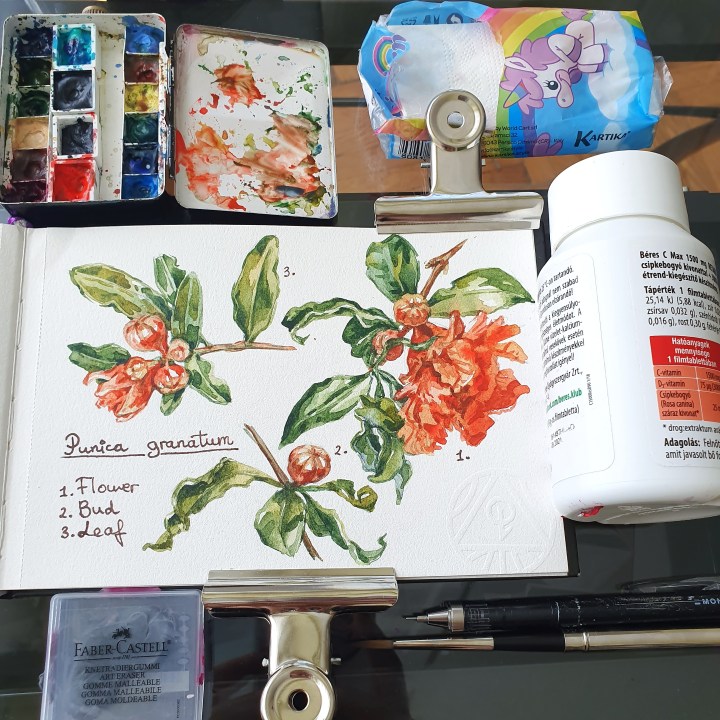
- Color is NOT equal to Pigment.
That is your key to understanding why sometimes you have so-called dirty color instead of something bright. Watercolor paint (that you see in a pan or tube) consists not of magic powder but of two important ingredients: gum Arabic and pigment. Gum Arabic is just a glue that allows your work to stay on paper. And the pigment is a powder made from some real material. You can check this wonderful website for pigment codes. So, for some PAINT manufacturers use up to 3-4 PIGMENTS. Keep that in mind. In watercolor, to achieve clean COLOR you need to blend not more than 4 PIGMENTS in your mixture. See where it is going? If you don’t know how many PIGMENTS are in your PAINT you have no idea of what you are actually mixing.
- Not any paper that is labeled as “watercolor” paper will work.
Sorry to say, even a price tag won’t help you to pick a good one. Yes, it should be 300 gr or more and for water techniques, that’s the base. If you just starting to paint – choose cellulose paper which is much cheaper than cotton and will be perfect for teaching you discipline. A lot of artists recommend painting only on cotton, but I cannot agree. Cotton is forgiving. Did you move too slow? It’s ok. Need to add more layers? It’s ok. Move too many times on one spot? It’s ok. And so on. It will make you feel that you are painting well when you are actually not. Cellulose won’t forget anything, but if your goal is to IMPROVE your skill – that’s the most effective path. Another thing ALWAYS stretch your paper to avoid waves on the paper. If the paper of the artwork is not even – it is a technical failure. Boo to that.
- There are NO multipurpose brushes.
A lot of students came to me claiming that their brush is perfectly fine and worked for everything. Well, I don’t want to be a party breaker but that is simply not true. It is like claiming that you have shoes that are perfect for winter, summer, desert, and north pole and also cost 10 dollars. That doesn’t sound realistic, right? Same here. Using acrylic brushes for watercolor is better than nothing I guess, but will never give you a proper experience. To have one, but a good watercolor brush makes much more sense than a full set of low-quality brushes.
Of course every of the topics that I mentioned in this post need further explanation, so stay updated for my future posts. Also, you are more than welcome to join my art classes in Budapest. Watercolour is always the focus of my classes and I’m happy to share my love and knowledge with others. If you would like to know more about my art workshops in Budapest please check this page for the detailed info.

Key words: art classes Budapest, art Budapest, artist Budapest, watercolor Budapest, urban sketching Budapest, art workshop Budapest


 OLGA LO